
“I had a cup of tea with God.” God or Nature
Dr. Boy van Droffelaar
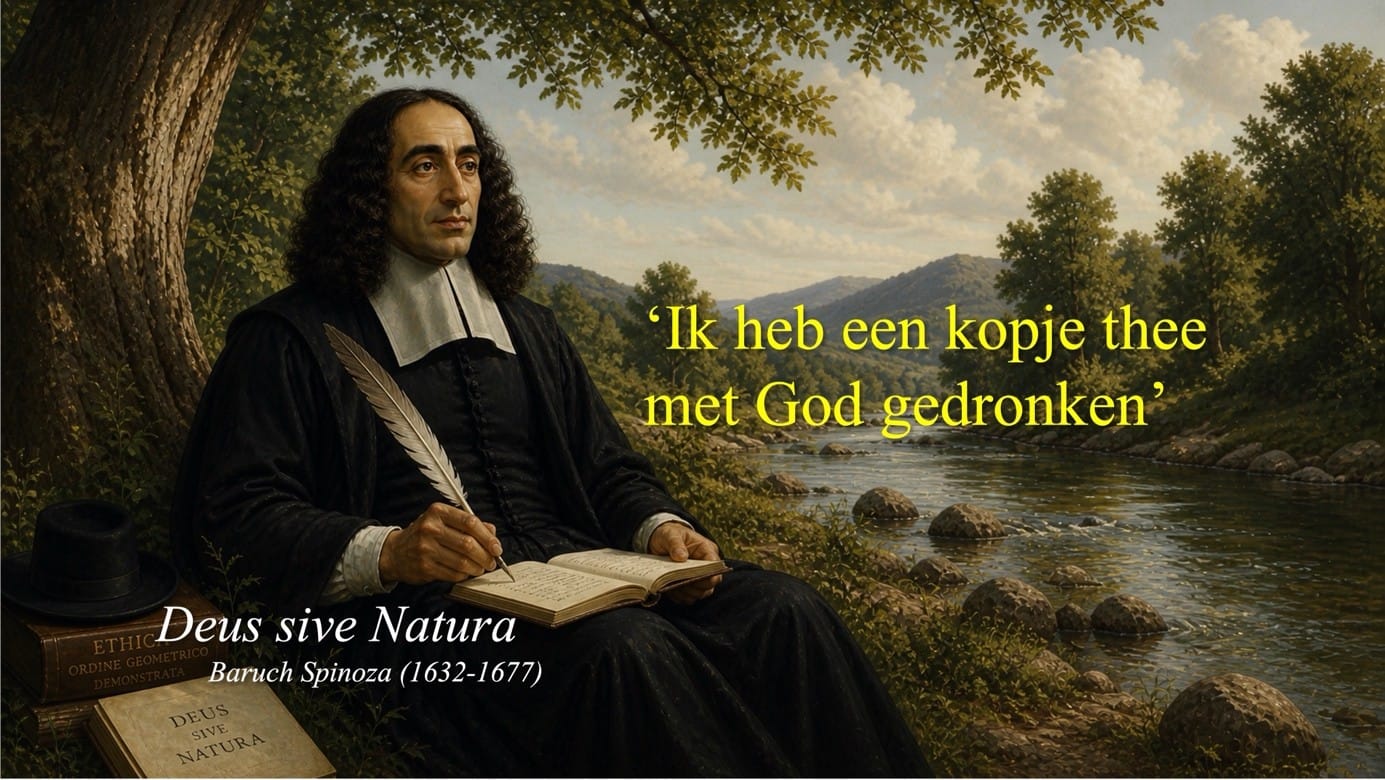
“I've had a cup of tea with God.” It was a simple sentence, spoken by a participant on the final evening after our trail, organised by the Foundation for Natural Leadership, in the beautiful, unspoiled nature of Imfelozi in South Africa. But within that simplicity lay a depth that cannot easily be reduced to words. We had spent five days and nights in a landscape that disregards human plans: under a sky that stretches beyond our comprehension, on earth that carries us without knowing us, surrounded by the sounds of birds, insects and unseen animals. In those circumstances, something happens to us. Something that cannot be forced, but does present itself when we open ourselves up to it.
In these circumstances, something happens to us that is difficult to put into words. Boundaries that we consider self-evident begin to blur: the separation between body and environment, between human and animal, between self and the cosmos. A feeling of connection arises, an experience of unity in which nature no longer stands opposed to us, but reveals itself as something of which we ourselves are an expression.
Consciousness expands, as if remembering a forgotten origin. We might think we have gone into nature, but in essence, we are returning to that from which we have never been separate.
This experience and the pronunciation of ‘the cup of tea with God’ reminded me of one of the greatest philosophers of all time that the Netherlands has produced: Baruch Spinoza (1632-1677).
Spinoza's radical simplicity
Spinoza’s life and thought form a remarkable combination of clarity and courage. Born in 1632 in Amsterdam into a prosperous Sephardic Jewish immigrant family, he grew up within a religious community that initially shaped him, but ultimately also rejected him. Because of his radical free-thinking views on God and the Bible, which were far ahead of his time, he gained great fame and renown at a young age. However, his ideas ignited the wrath of the rabbis, and on 27 July 1656, the Cherem (excommunication) was pronounced against him for ‘horrendous heresies’: all members of the community were warned to stay away from Spinoza and to do no business with him. His family members were also forbidden from having any further contact with him or supporting him in any way.
What follows is not a story of rebellion, but of quiet perseverance. Spinoza accepts his fate, lives frugally, earns his keep as a lens grinder – for his friend Christiaan Huygens, among others – and dedicates himself to his thoughts. In relative seclusion, he develops a philosophy that has lost none of its power to this day.
He lived successively in Rijnsburg, Voorburg, and The Hague. He struggled with his health, but he tirelessly continued his thinking and writing. He had many admirers in his time, but also after, such as Leibniz, Johan de Witt, Joan van Oldenbarnevelt, Goethe, Nietzsche, Hegel, Jung. Also Abbey Einstein admired him: ‘I believe in God, the God of Spinoza’. Spinoza died in 1677 at the age of 44 from a lung condition.
ETHICA, Spinoza's masterpiece
Spinoza completed his most famous work, ETHICA, in 1675, and it was published posthumously in 1678.
In Chapter 1 of ETHICA, Spinoza gets straight to the point. He formulates a thought that is both simple and disruptive: Deus sive Natura (God, or Nature). With this statement, Spinoza breaks down an age-old division. God is no longer a transcendent creator who stands outside the world. God Is the world – not as a collection of things, but as the infinite reality of which everything is a part. Everything that exists is an expression of that one substance.
God as an omnipresent natural force
Spinoza therefore equates God with Nature, by which he means not only all trees, plants, and animals, but also humanity itself, the Earth, all planets, thus the entire cosmos and all the Natural Laws that underpin it. According to Spinoza, God is not a wise, moral, or majestic creator of the world; no, he says, God is omnipresent as an active natural force, which is the cause within itself (causa sui). He is present in everything, and always has been and always will be. In short, this God is not far away, but omnipresent. Not as a spectator, but as an active, creative force.
What does this mean for us? It means that we are not separate beings living in a strange world. We are not outsiders. We are not accidental passers-by. We are part of Nature – and thereby part of God. Spinoza calls us ‘modes’: expressions of the one substance.
The wilderness as an experience of Spinoza’s insight
Could it be, I wonder, that this presence of Spinoza's God is felt when, in the wilderness, we experience a unity in which Nature no longer stands opposed to us, but reveals itself as something of which we ourselves are an expression? That we have thus had a cup of tea with Spinoza's God?
Perhaps, because when we go on trails in the wilderness, when we place our feet on earth that has not been shaped by us but that carries us without intent or preference, we are not merely entering a landscape, but a reality that precedes and encompasses us. We may think we are going into Nature, but in essence, we are returning to that from which we have never been separated.
If Baruch Spinoza had joined us on the trail, he might have gently, but with great clarity, reminded us of a simple yet all-encompassing insight: we are modes, expressions of one and the same substance: Deus sive Natura. This does not mean that we disappear into Nature, but that we understand we have always been a form of it. Just as the wave is no different a being than the sea, so we are no different a being than Nature itself, which expresses itself in us in a particular way.
So we are present – as part of a larger whole that brings itself forth and sustains itself. Spinoza calls that which brings itself forth ‘causa sui’. God or Nature needs no cause outside itself. It is its own ground. And because we are part of that Nature, we are expressions of the same power that brings everything forth.
This insight can free us from a deep-rooted misconception: that we are opposed to Nature, that we must control or fear her.
When we are out on the trail, we experience firsthand how little of that attitude remains. We cannot order the rain to stop, we cannot hold back the night. And yet, we experience no humiliation in this, but rather a form of peace. Because what we lose is the illusion of control. And what we gain in its place is the awareness of participation, of connection.
If we were to walk with Spinoza by a river and see the light break on the water, if we heard a bird call in the distance, something subtle happens. Not because these things specially exist for us, but because we begin to experience without the intervention of our habit of naming and possessing everything. We let things be what they are. And in that letting, that releasing, says Spinoza, something essential happens, we experience the source of everything from which a shift unfolds within us.
We may feel small in this vastness. But Spinoza would correct us: small and large are merely relative concepts. Just like good and evil. In reality, we are as necessary as the tree, as the stone, as the cloud that drifts by. Everything that exists follows from the Nature of God with the same inevitability. We are no less, but also no more.
Natura naturans and natura naturata
Even as we walk, Spinoza would also tell us that he makes a distinction between ‘natura naturans’ and ‘natura naturata’. The first is nature as the producing force; the second is nature as that which has been produced. On our trail, we see both, even if we don't necessarily name it as such. When we witness the growth of plants, the movement of animals, the constant change of light and shadow, we see ‘natura naturata’: the forms in which nature expresses itself. But when we are touched by the feeling that everything is in motion, that everything originates from one and the same source, then we experience a glimpse of ‘natura naturans’: the living, creative force itself, within which we are included. When this happens, a feeling of unity arises that is difficult to describe, but is deeply recognisable to those who have experienced it.
Parallels to the present day
It was Immanuel Kant who posited that we can never know the ‘Ding an sich’ – the thing-in-itself. We only experience how reality appears to us; how it truly is, remains hidden from us behind an impenetrable veil, according to him. In a sense, one could say that in doing so, albeit implicitly, he touches upon what Baruch Spinoza refers to as ‘natura naturans’: the creative, generative ground of all that is.
Even in our time, it becomes apparent how far-sighted this thinking was. What Spinoza calls “thinking” can be understood today as consciousness. In that light, Analytical Idealism offers a contemporary philosophical and scientific approach, in which consciousness is no longer seen as a by-product of matter, but as fundamental reality itself. All physical phenomena then appear as manifestations of a universal consciousness.
Those moments of profound experience in the wilderness – that sudden glimpse of oneness, that intensity of presence – can be understood within this framework as a temporary breaking down of the boundaries that normally separate our individual consciousness from that greater whole, like a wave in the sea. In such moments, it seems as though we, if only for a brief instant, come into contact with what Spinoza calls ‘natura naturans’: the living, creative force in which everything is rooted. If Spinoza were alive today, would he agree to equate universal consciousness with ‘natura naturans’?
Encounter as recognition
Returning to Spinoza himself. Sometimes we encounter an animal in the wilderness, such as an Elephant, a Rhinoceros or an Antelope. We look, and the animal looks back. There is no language, no agreement, no shared plan. And yet, there is a moment of recognition. A glance. A silence.
For Spinoza, that is no mystery. It is the most natural thing in the world. For if everything that exists is part of the same substance, then every encounter is, in a sense, an encounter with ourselves.
Not as an individual, but as an expression of the same life.
We'll sit alone for a few hours, in silence, in a beautiful spot overlooking the river. We will see, listen, feel. The wind moves through the leaves, and without us being able to precisely pinpoint it, our relationship with our surroundings changes. We are no longer spectators. But we are not dissolved either.
We are present — as part of a greater whole that generates and sustains itself. Baruch then whispers to us: this is not a fleeting emotion, but a glimpse of insight — a moment in which we not only understand, but also feel, the coherence of the whole. We are a form in which Nature experiences itself.
The return
Every trail ends. We return to the world of appointments, obligations, and words. But something has changed. Not because we've added anything, but because we've let something go.
We have experienced – if only for a moment – that we are not opposed to nature, but within it. That we are not spectators, but participants. That what we call “I” is not an island, but a wave in an endless sea.
We've just seen that there's another way of are possible. A way that is less about control, and more about connection.
The wilderness as teacher
The stories of people who venture into the wilderness show a remarkable similarity. They speak of being reborn, of rediscovering their deepest values, of a silence that purifies and strengthens them. They learn to listen, to truly listen – to Nature, to others, but also to themselves. They discover a form of presence that is often lost in daily life.
What they experience is not an escape from reality, but a deeper understanding of it.
Thus, the wilderness proves to be a profound teacher. It teaches us that we are not separate from the world, but that we stand right in its midst, embedded and connected. It confronts us with our illusions of isolation and control, and opens us to a reality in which everything is interwoven with everything else. Whoever truly allows themselves to be moved by Nature discovers that life is not a coincidental confluence of blind forces, but a meaningful whole in which we are at home. Or, in the words of Spinoza: we are part of a necessary, unavoidable whole.
Slot: the simplicity of what always was
If Spinoza had walked beside us, he probably wouldn't have said much. He wouldn't have used elevated language, wouldn't have made a grand gesture.
He would have simply pointed to what had always been there.
And perhaps we would then understand that the statement – “I had a cup of tea with God” – is not an exaggeration, but an attempt to name something that actually defies language.
That we, in all our forms and thoughts, are part of one and the same reality.
That we were never truly separated.
That God, or rather Nature, is not somewhere else.
But here.
Always.
In everything.
Boy Van Droffelaar, PhD

